EPICS IOC On Board
D‑TACQ Intelligent digitizers work with EPICS .
.
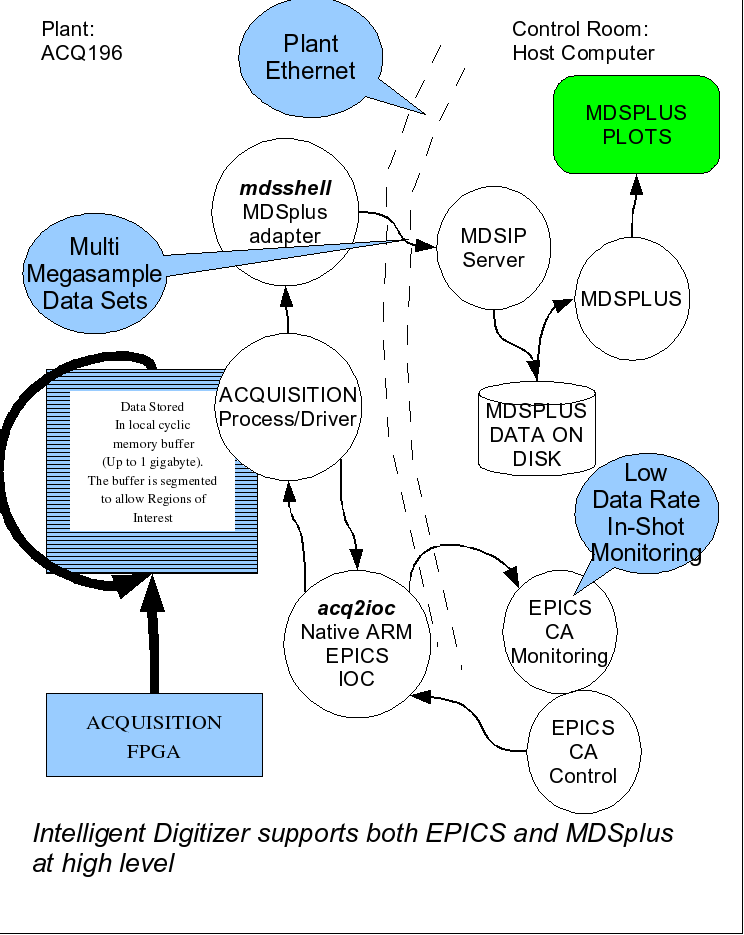
Each card is a networked Linux system and the EPICS IOC has been ported to run onboard, this means that D‑TACQ digitizers need only an Ethernet connection in order to participate in an EPICS control system, publishing data using standard EPICS Channel Access. Works with off-the-shelf linux-arm architecture in EPICS BASE 3-14-11.
Two device support layers are provided:
- dsSysfs A Device Support layer dsSysfs makes linking device files to EPICS records easy. "No Drivers Required". Any system file with a scalar content (eg /proc/uptime) may be hooked. This works really well on ACQ196, since virtual file "knobs" are provided for most parameters.
- lxb Linux Binary - provides highly efficient support for Digital Inputs. We provide a standard Linux device driver with a blocking read() call, returing on Change Of State (COS). The device support hooks each state bit to a BI record in the EPICS db. This model could easily be applied to any DI device - including the ACQ196 DIO32 port on the RTM and the 128bit third party "Adlink" cp7542 isolated DIO module.
Typical use case:
Continuous capture with low rate trend data provided by AI records. Capture stops on a trip condition, then full rate pre/post data is presented in the Waveform record.
Combined Process Controller and Transient Digitizer.
Standard record support includes:
- Analog Input AI trend data - per channel rolling average during full rate capture to memory
- Waveform records update analog input data on completion of transient capture.
- Simple start/stop controls, acquisition state monitoring.
- System health monitoring - card temperature and heartbeat.
- Analog Output AO records where AO channels are fitted. (eg RTM-AO16).
- BI/BO records to interface to DIO32 (32 bit bit-programmable DIO port).
- BI records to monitor system clocks and triggers.
- Easy to add simple sequences - eg analog ratio crossing triggers digital output alarm.
- Future options - MBBI records to access 32 bit DIO port, local Serial port [UART] access.
- Easy to add additional ports: octal serial UART, using built-in system slot functionality to host CPCI peripheral cards and/or PMC modules
- Support for D‑TACQ AO32CPCI - 32 AO records, AWG, 64 bit BO,
- Support for ADLINK CP7452 - 128 BI, 128 BO.
Resources:
Embedded EPICS for control, MDSplus for data - get the best of both worlds